
When HR and Technology Co-Design the Future of Work
How do you grow the business significantly without growing headcount at the same pace?

How do you grow the business significantly without growing headcount at the same pace?

Over the past few months, as a Fractional AI and Technology leader, I supported a large FMCG multinational in Singapore to answer this exact question.
The ambition was very clear but the constraints were also very real.
The initial brief looked straightforward: Set up an “AI Hub”. The underlying assumption was that a Center of Excellence would act as a catalyst, sprinkling “AI magic” across the organization to create efficiency.
However, it quickly became clear that this was not a technology project. It was an organizational redesign challenge.
Building an “AI Hub” would likely result in silos that would produce pilots nobody uses. The real work lay in understanding how humans, AI, data, and processes should collaborate so that growth becomes repeatable.
That required HR and Technology to share ownership of the same challenge.
Here is what we learned on the journey, and the model we built to solve it.
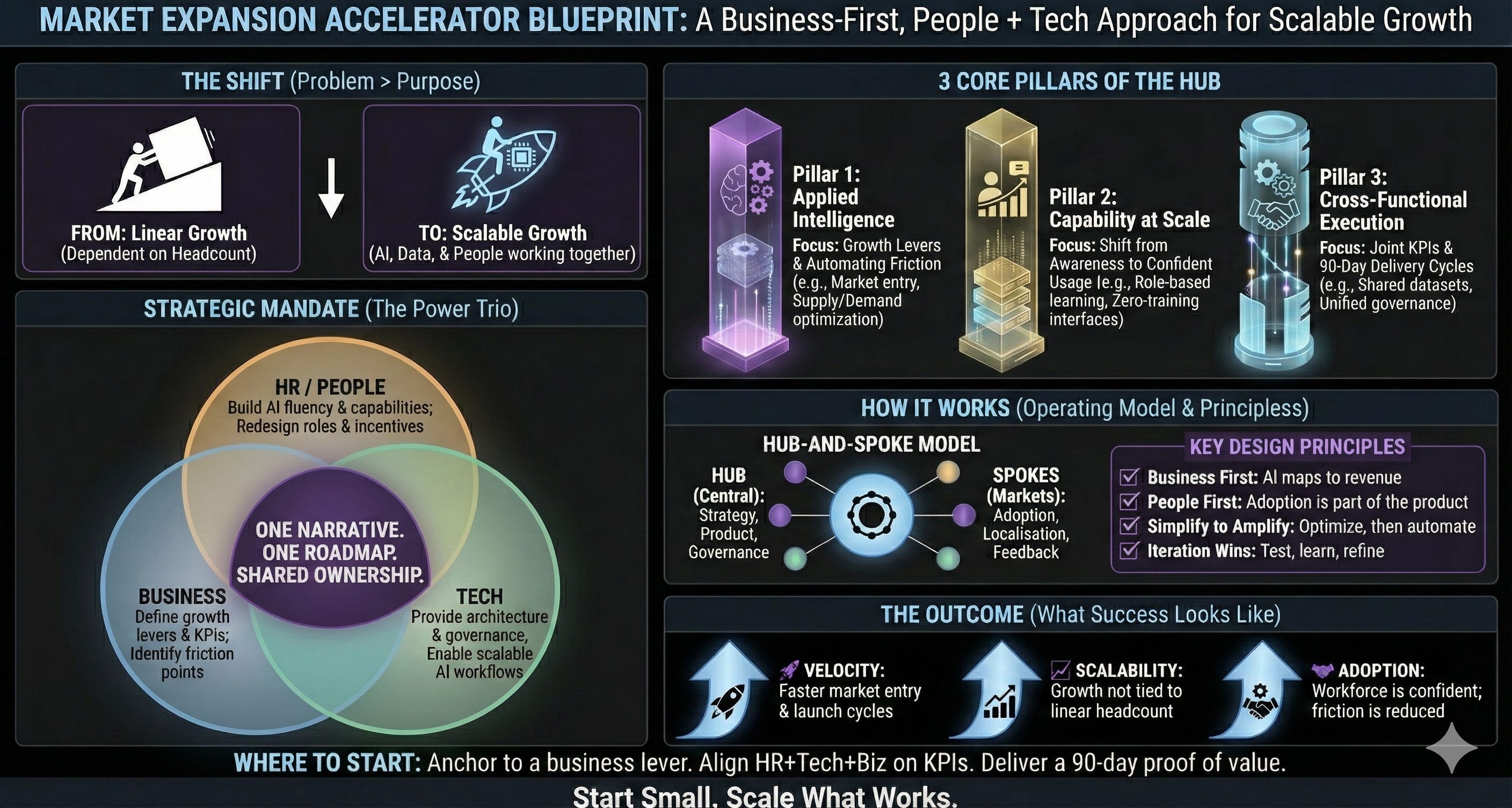
The Pivot: From “AI Hub” to “Market Expansion Accelerator”
We realized that “building capabilities” is a cost center, but “expanding markets” is a revenue driver.
We scrapped the “AI Hub” name. This matters. Names signal intent. An AI Hub signals experimentation; a Market Expansion Accelerator signals business outcomes.
We anchored this accelerator on three pillars to ensure we weren’t just building tech, but building a growth engine.
1. Automation is where the friction is
We stopped looking for generic AI use cases and looked at the hardest part of their business goal: Entering new markets faster.
In practical terms, we asked: Why does it take months to understand a new market?
Who do we partner with for distribution?
What is the optimal pricing strategy?
What are the local compliance requirements?
How do we localize brand messaging instantly?
This produced concrete, boring, and high-value use cases:
Market entry playbooks generated by analyzing regulatory data.
Distributor copilots to aid local sales teams.
Content pipelines that localize marketing assets in hours, not weeks.
No moonshots. Just boring (!), compounding improvements to the speed of business.
2. Capability: Fluency over Engineering
We focused on “AI Fluency” for the general workforce. We didn’t need more AI engineers. We needed people who could use AI safely, spot opportunities, and challenge outputs.
People needed to:
know when AI helps and when it does not
use it safely in their role
judge outputs and propose improvements
identify which tasks should be automated next
We developed:
role-based experiential learning journeys
AI Ambassadors in key markets
conversational interfaces over dashboards
a design principle targeting “zero training” user interfaces (if the tool required a manual, the UX was too complex.)
Useful, usable, used!
Read more on this design framework here.
3. Collaboration: HR and Tech as One System
This was the critical unlock. We designed cross-functional squads with shared KPIs:
Time to open a market
Time to launch a SKU
adoption of new workflows
By unifying the governance, we would ensure that when a process is automated, the role description and performance metrics would change immediately to match.
The 6 Questions That Mattered More Than Tech Stack
We avoided getting bogged down in tool selection by focusing on the questions that determine business value:
The Goal: How can AI help us grow faster without adding equivalent headcount?
The Split: How should work be practically split between humans (judgment), AI (drafting/analysis), and automation (routing)?
The Design: What needs to change in our org design, roles, and incentives to make this real?
The Buy/Build: Which capabilities must be in-house versus with partners?
The Safety: How do we keep people confident and motivated in hybrid human–AI workflows?
The Scale: How do we replicate this across cultures without losing coherence?
This disciplined framing would prevent the usual AI “shopping list” and keep us anchored to outcomes.
Why This Is a Trend, Not a Fad
Our approach mirrors a broader shift I am seeing in the market. Forward-thinking organizations are merging the “People” and “Tech” agendas because you can no longer separate the worker from the workflow.
Moderna merged HR and IT under a single Chief People and Digital Technology Officer to align workforce planning with AI investments (Forbes).
Covisian (CX outsourcer) combined HR and IT to unify workflow design (BBC).
Workleap folded IT into the people function to fix onboarding friction (Fortune).
The forces driving this are:
1. Workflows determine value
In an era of “Agentic AI,” the handoff between human and machine defines efficiency:
AI drafts; humans decides
Systems triages and routes; people handle exceptions
AI copilots suggest; leaders exercise judgment
....
This forced us to confront practical questions:
Where does accountability sit when an AI-recommended action is taken?
What belongs to a role versus what belongs to a system?
Where does human judgment add value, and where does it add latency?
How do we redesign processes so they fit a human-plus-AI operating model?
So these are workflow redesign questions, not really “IT vs HR” questions.
2. Roles are fluid
As automation handles volume, roles shift toward judgment. HR must evolve skills frameworks in near real-time:
roles shift toward judgment and exception handling
skills frameworks must evolve continuously
performance reviews must account for tool-amplified output
incentives need to reward adoption and process redesign
If HR and Tech work separately, org design lags behind system design (or the other way around).
3. Governance is shared
You cannot govern AI without governing the people who use it. Accountability becomes shared:
who is responsible for an AI-suggested action
how fairness and transparency are ensured
how work is redistributed when steps are automated
Unified HR–Tech governance creates speed, clarity, and consistency. This industry direction validated our own approach: workflow, capability, and system architecture had to move together.
The operational questions enterprise leaders cannot avoid
In the end, the future of work shows up in day-to-day leadership decisions:
Complementarity: Where exactly should AI handle volume and speed—and where should humans intervene?
Process redesign: Which processes should be simplified or rebuilt entirely?
Performance and incentives: How do we evaluate output when tools amplify productivity Do we reward adoption and workflow redesign?
Scaling across markets: What is non-negotiable (data standards, controls), and what can adapt locally?
Diversity of thinking: How do we preserve challenge and dissent in a system optimised for efficiency?
These questions determine whether AI becomes a value multiplier or a source of friction.
What I would insist on if starting again
A few principles proved non-negotiable:
Business first: AI must map to growth levers.
People first: adoption and fluency are part of the product.
Simplify to amplify: AI should remove steps, not automate chaos (!)
Train for the right sport: build capabilities your business model needs.
Mindset drives execution: teams must test, learn, and adjust continuously.
Leadership involvement and alignment matters: HR, Tech, and Business need one story, one set of metrics and need to lead by example.
Without this, it will be hard to keep things moving and scale.
Closing Thought: The Leadership Mandate
The future of work is not about replacing people with AI. It is about designing work so that people and AI do different things together, deliberately, and at scale.
For my client, success didn’t come from a new software license. It came from deciding that HR and Technology were co-owners of the growth target.
If you are on a similar journey, my suggestion is simple:
Start from the business goal. Map the real frictions. And make HR and Technology sit at the same table to solve it.
It makes everything else easier.
I’d love to hear how you are structuring your own AI governance!
Thanks for reading,
Damien
I am a Senior Technology Advisor who works at the intersection of AI, business transformation, and geopolitics through RebootUp (consulting) and KoncentriK (publication): what I call Technopolitics. I help leaders turn emerging tech into business impact while navigating today’s strategic and systemic risks. Get in touch to know more damien.kopp@rebootup.com